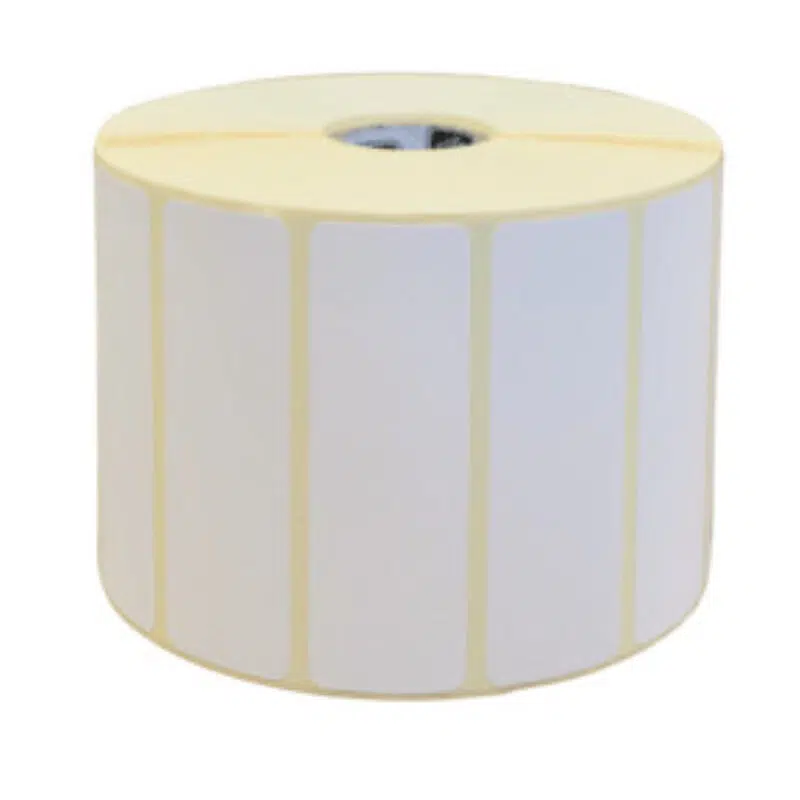
TSC Linerless Labels

TSC linerless labels put up to 40% more label length on every roll you buy, while cutting greenhouse gas emissions by up to 30% compared to conventional liner-backed stock. If your operation runs TSC printers and you are still peeling silicone-coated backing paper into a bin, this page covers everything you need to choose the right format, match it to your printer, and make the transition with confidence.

Delfi Technologies has supplied TSC printing solutions to Danish warehouses, retailers, and logistics operators since 1988. The TSC linerless label rolls in our webshop cover the most common desktop and mobile formats, priced in DKK and ready to ship.

What TSC linerless labels actually are

A linerless label is a pressure-sensitive label on a roll with no silicone release liner on the back. The adhesive is exposed, and the printer uses a special anti-stick platen and print path to feed the material without jamming. TSC Auto ID coats the face of each roll with a release layer so the adhesive does not bond to the layer above it on the roll.

The result is more labels per roll. TSC’s own figures state up to 40% more paper length per roll when the liner is removed. Because you are also shipping less dead weight, each equivalent label volume weighs 40% less in transit. That reduction compounds quickly across high-volume inbound orders.

For Danish businesses with sustainability reporting obligations, the numbers are specific enough to be useful. TSC’s EMEA data shows a 30% reduction in greenhouse gas emissions, 40% water savings from eliminating the glassine liner manufacturing process, and 40% less shipping weight per equivalent label volume. These figures reflect the difference in material inputs between liner and linerless production, not rounded estimates.

Food and drink manufacturers are among the fastest adopters of linerless labels globally, with transport and logistics following closely as e-commerce volumes rise. Both sectors are well represented in Delfi’s Danish customer base.

Filter

At Delfi Technologies, you will find a wide selection of tsc tsc linerless labels for professional needs. Make your business more efficient with tsc linerless labels

TSC linerless label formats: desktop, mobile, and industrial

TSC produces linerless labels in three broad format families. Choosing the wrong core diameter or outer diameter for your printer is the most common sourcing mistake, so the table below summarises the verified specifications for desktop and mobile formats.

Format family

Label width

Core diameter

Max outer diameter

Typical use

Desktop

Up to 4 inches (101.6 mm)

1 inch (25.4 mm)

5 inches (127 mm)

Fixed workstation labelling, shipping, retail

Mobile

1 inch to 4.4 inches

0.75 inch (19 mm)

2.625 inches (66.7 mm)

Warehouse picking, direct store delivery, mPOS


Industrial formats are available on request. Contact Delfi or visit the TSC brand page for details on high-volume production configurations.

Custom formats are available from TSC starting at 37 mm width, with adhesive options covering temporary, semi-permanent, and permanent bonds. The right adhesive type depends on your application, which the next section addresses directly.

Choosing the right adhesive type for your application

TSC linerless labels are not a single product. The adhesive formulation changes the label’s behaviour significantly, and picking the wrong type creates problems that no printer setting can fix.

Temporary adhesive

Temporary adhesive labels bond lightly and can be repositioned or removed cleanly. They suit retail markdown tags, promotional shelf labels, and any application where the label needs to come off without leaving residue. Direct store delivery operations often use temporary adhesive for in-store price changes.

Semi-permanent adhesive

Semi-permanent adhesive holds firmly under normal conditions but releases with deliberate effort. This is the most common choice for general warehouse labelling, pick-and-pack operations, and logistics labels where the label must survive transit but does not need to be permanent.

Permanent adhesive

Permanent adhesive bonds aggressively and is not intended for removal. It suits product identification labels, asset tags, and compliance labels where the label must remain in place for the product’s lifetime. OSHA compliance labelling in warehouse environments often requires permanent adhesive to prevent labels from detaching and creating floor hazards.

If you are unsure which adhesive type your application needs, the Delfi team can advise based on your substrate, environment, and removal requirements. The printer model you use does not change with adhesive type, but cleaning frequency may increase with more aggressive adhesives.

Compatible TSC printer models

TSC linerless labels only work in printers designed with an anti-adhesive print path. Standard TSC printers are not compatible without modification. The following models are confirmed linerless-capable.

Mobile printers

The TSC Alpha-40L is a 4-inch mobile printer with USB-C, Bluetooth, Wi-Fi, and NFC connectivity, printing at 203 dpi. It handles linerless rolls natively and is available with a peeler option for automatic label separation. The Alpha-40L with peeler and extended battery suits high-volume mobile labelling in warehouses and distribution centres. Both the Alpha-30L and Alpha-40L withstand drops from up to 1.8 metres (6 feet) with continuous print capability, which matters in environments where handhelds are regularly dropped.

The Alpha-2R is a 2-inch cost-effective mobile option with Energy Star 2.0 certification and an IP42 dust and water resistance rating. It suits lighter-duty mobile applications where battery life and environmental compliance are priorities.

Desktop printers and upgrade kits

The MB240 and MB241 series desktop printers can be converted to linerless operation using the TSC linerless tear-off upgrade kit or the TSC linerless cutter upgrade kit. These kits replace the standard media path components with anti-adhesive equivalents, allowing existing hardware to support linerless media without a full printer replacement.

The DH220 and DH220HC models accept the linerless cutter upgrade kit for the DH series. The DH series is TSC’s direct thermal desktop line and a common platform in Danish retail and light industrial environments.

Browse the full range of linerless label printers from TSC to compare current models and connectivity options.

The vertical DPI correction feature explained

One technical detail that separates TSC linerless printers from generic alternatives is the vertical DPI correction function. Because linerless labels have exposed adhesive on the underside, they create slightly more friction against the platen roller than liner-backed media does. This friction can cause the label to feed fractionally slower than the print head expects, stretching printed content vertically and making barcodes scan incorrectly or text appear elongated.

TSC’s vertical DPI correction compensates for this by adjusting the print engine’s feed rate to match the actual movement of the linerless media. The printer measures the deviation and corrects it in firmware, so the printed output matches the intended dimensions regardless of adhesive tack level. This is a firmware-level feature built into compatible TSC models. It is not available as an aftermarket addition to non-TSC hardware.

For barcode-heavy applications, this matters. A barcode that prints even slightly longer than specified can fail scanner verification at the receiving end. Vertical DPI correction eliminates that failure mode without requiring manual calibration every time you change rolls.

Maintenance: keeping linerless printers running cleanly

The most common objection to linerless printing is adhesive buildup. Because the adhesive is exposed throughout the print path, residue accumulates on the platen roller, the print head, and the cutter over time. TSC addresses this through two design choices and one maintenance product.

First, TSC linerless printers reduce the number of contact points throughout the media path. Fewer surfaces touching the adhesive side of the label means less residue deposited per roll. Second, the cutter design includes a lock sensor, an upper blade protector, and a lower blade auto-ejection mechanism, which prevents adhesive from jamming the cut mechanism and allows the blade assembly to be cleaned without disassembly.

The TSC linerless cleaning kit handles the rest. Using the kit, a full clean of the printer and cutter takes under 5 minutes. TSC recommends cleaning after every roll change for high-adhesive media, or at regular intervals for standard semi-permanent stock. For operations running multiple shifts, scheduling a clean at each shift handover is a practical starting point.

Neglecting cleaning shortens print head life and increases the risk of paper jams. The 5-minute cleaning claim is realistic for a trained operator and does not require specialist technical knowledge.

Buying criteria: what to check before ordering

Four questions determine whether a specific TSC linerless label roll will work in your environment.

1. Printer compatibility

Confirm your printer model is on the TSC linerless-compatible list before ordering labels. Using linerless media in a standard printer will cause jams and may damage the print head. The upgrade kits for MB240, MB241, and DH220 series printers are a cost-effective path if your hardware is not natively linerless-capable.

2. Label width and core diameter

Match the label width to your printer’s maximum media width. Desktop printers accept up to 101.6 mm; mobile printers accept up to 4.4 inches. Core diameter must match your printer’s spindle: 1-inch core for desktop, 0.75-inch core for mobile. Ordering the wrong core means the roll will not seat correctly.

3. Roll length and box quantity

The 32-metre roll (18 per box) suits mobile printers and lower-volume desktop use. The 320-metre roll (2 per box) reduces roll changes on high-throughput desktop printers. Calculate your daily label volume and multiply by roll length to estimate how many roll changes per shift you will need. TSC provides a Paper Roll Calculator on their website to help with this before you commit to a format.

4. Adhesive type

Temporary, semi-permanent, and permanent adhesive options are available in custom formats from 37 mm width. Standard stocked rolls at Delfi use a general-purpose adhesive suitable for most warehouse and retail applications. If your application involves unusual substrates, extreme temperatures, or regulatory requirements, specify the adhesive type when ordering.

Where TSC linerless labels deliver the most value

Warehouse and logistics operations benefit most directly. Liner waste on warehouse floors is a slip hazard and a compliance issue in markets where OSHA-equivalent standards apply. Eliminating the liner removes the waste stream entirely rather than requiring a separate collection and disposal process. Mobile printers like the Alpha-30L and Alpha-40L are designed for exactly this environment, combining linerless capability with 1.8-metre drop resistance.

Retail and direct store delivery operations gain from the repositionable temporary adhesive option. Price change labels, promotional tags, and shelf-edge labels that need to come off cleanly are well suited to this format. The compact mobile format also suits mPOS receipt printing where a single device handles both receipts and labels.

Food production and processing environments benefit from the sustainability angle. With food and drink manufacturers under increasing pressure to reduce packaging waste, switching label stock is one of the faster changes a production manager can make. The 40% reduction in shipping weight per equivalent label volume also reduces inbound logistics costs across high-volume operations.

For operations already running TSC desktop printers, the upgrade kit route means linerless printing does not require capital expenditure on new hardware. The linerless cutter kit for the MB240 series and the DH220 linerless cutter upgrade are the two most common conversion paths.

TSC linerless labels vs. standard TSC label stock

Roll handling changes. Linerless rolls have exposed adhesive on the outer surface, so they should not be stored loosely where they can pick up dust or debris. Keep rolls in their original packaging until use and store them at room temperature away from direct sunlight.

Printer setup takes slightly longer the first time. Loading linerless media requires threading the label through the anti-adhesive print path correctly. The process is documented in TSC’s printer manuals and takes a few minutes to learn. After the first load, it is no slower than standard media.

Cleaning frequency increases modestly. Standard label stock leaves almost no residue; linerless stock leaves a small amount of adhesive on the platen and print head over time. The 5-minute cleaning kit procedure handles this, but it needs to be scheduled rather than ignored.

On cost, the per-roll price of linerless stock is comparable to standard thermal direct labels, and the higher label count per roll means the effective cost per label is lower. The 320-metre roll at 499 DKK delivers significantly more labels than a standard roll of equivalent outer diameter. That is where the economic case for switching becomes concrete.

Browse the full TSC product range at Delfi to compare linerless and standard label options side by side, or go directly to the linerless labels category to see current stock and pricing.

Frequently asked questions about TSC linerless labels

Only if your printer model is designed or upgraded for linerless media. Standard TSC printers will jam with linerless stock because the print path is not coated to resist adhesive. Check whether your model is on the compatible list or whether an upgrade kit is available. The MB240, MB241, and DH220 series all have upgrade kits in stock at Delfi.

The standard stocked width is 100 mm, available in 32-metre rolls (18 per box) and 320-metre rolls (2 per box). Custom widths from 37 mm are available through TSC’s Genuine Supplies programme. Contact Delfi for lead times and minimum order quantities on custom formats.


TSC linerless labels are available in temporary, semi-permanent, and permanent adhesive formulations. Temporary adhesive suits retail price tags and promotional labels. Semi-permanent is the standard choice for warehouse and logistics labelling. Permanent adhesive is used for compliance labels and asset tags that must not be removed. Custom formats from 37 mm width can be specified with any of these adhesive types.


Use the TSC linerless cleaning kit. The kit includes the materials needed to clean the print head, platen roller, and cutter assembly. A full clean takes under 5 minutes. The cutter’s lower blade auto-ejects for cleaning access, so you do not need to disassemble the unit.

Yes, provided the printer’s vertical DPI correction is active. TSC linerless printers include firmware-level feed rate correction to prevent adhesive friction from stretching barcodes vertically. Without this correction, Code 128, EAN-13, and other linear symbologies can fail scanner verification. All TSC linerless-compatible printer models include this feature.

The printer measures the difference between the expected and actual feed rate caused by adhesive friction, then adjusts the print engine output in firmware. The result is that barcodes and text print at their specified dimensions regardless of the adhesive tack level. You do not need to recalibrate manually when changing rolls.

Order TSC linerless labels from Delfi Technologies

TSC linerless labels are in stock at Delfi Technologies, priced in DKK with direct support from a team that knows the hardware. The 320-metre desktop roll starts at 499 DKK and the 32-metre mobile format in an 18-roll box is 519 DKK.

If you need a linerless-capable printer alongside your labels, the linerless printer category lists current models with full specifications. For upgrade kits that convert existing TSC hardware, the MB240 tear-off kit and the DH220 cutter kit are the two most common starting points. Questions about compatibility or custom formats can be directed to [email protected].